
Guides · EU AI Act
Labelling AI chatbots: what the EU AI Act requires from your store
Since 2 August 2026 an AI chatbot has to tell your customers that it is an AI. That is what Article 50 of the EU AI Act says, and it applies to small stores too. The good news: the effort is small once you know where the notice has to go.

Where is my order?
Hi, I am the Haferhain AI assistant. Your parcel has been on its way since this morning.
We run an online store ourselves and worked our way through the regulation and the guidelines. Here is what matters day to day.
In short
- Customers must be able to tell, by the first message at the latest, that they are writing with an AI.
- The duty falls first on the provider of the chat software. If you build the bot yourself, you are the provider.
- A notice in the privacy policy is not enough. It has to be in the chat.

Contents
What Article 50 requires for chatbots
Article 50(1) requires that people are informed when they interact directly with an AI system. That covers every chatbot that answers customer questions on its own, whether in the chat widget, on WhatsApp, by email or on the phone.
Paragraph 5 covers the how: the notice must come at the first interaction at the latest and be clearly distinguishable and accessible.
Since when does this apply?
The transparency obligations have applied since 2 August 2026. The Digital Omnibus postponed some AI Act deadlines in summer 2026, but chatbot labelling is not among them.
- Regulation in forceThe AI Act, Regulation (EU) 2024/1689, enters into force.
- Commission guidelinesNot binding, but they show how authorities will read Article 50.
- Chatbots must identify themselvesParagraph 1 applies, with no transition period and for small stores too.
- Machine-readable markingParagraph 2 for systems already on the market before 2 August.
So only the machine-readable marking of AI content (paragraph 2) was postponed, and only for systems already on the market. For your chatbot nothing changes.
Who is obliged: you or your software provider?
The duty in paragraph 1 is addressed to the provider of the AI system, the party that develops the chatbot and makes it available under its own name. The provider has to build the system so that it identifies itself.
| Your situation | Your role | What you have to do |
|---|---|---|
| You use a ready-made chat tool | Deployer | Check that the notice is really visible in your store, and do not switch it off |
| You build the bot yourself or have it developed under your brand | Provider | Build in the labelling yourself and make sure it works |
As a deployer you are not off the hook either. If your bot is called “Lisa”, carries a photo and hides the AI notice, that comes back to you.
Hi, I am Lisa! How can I help you?
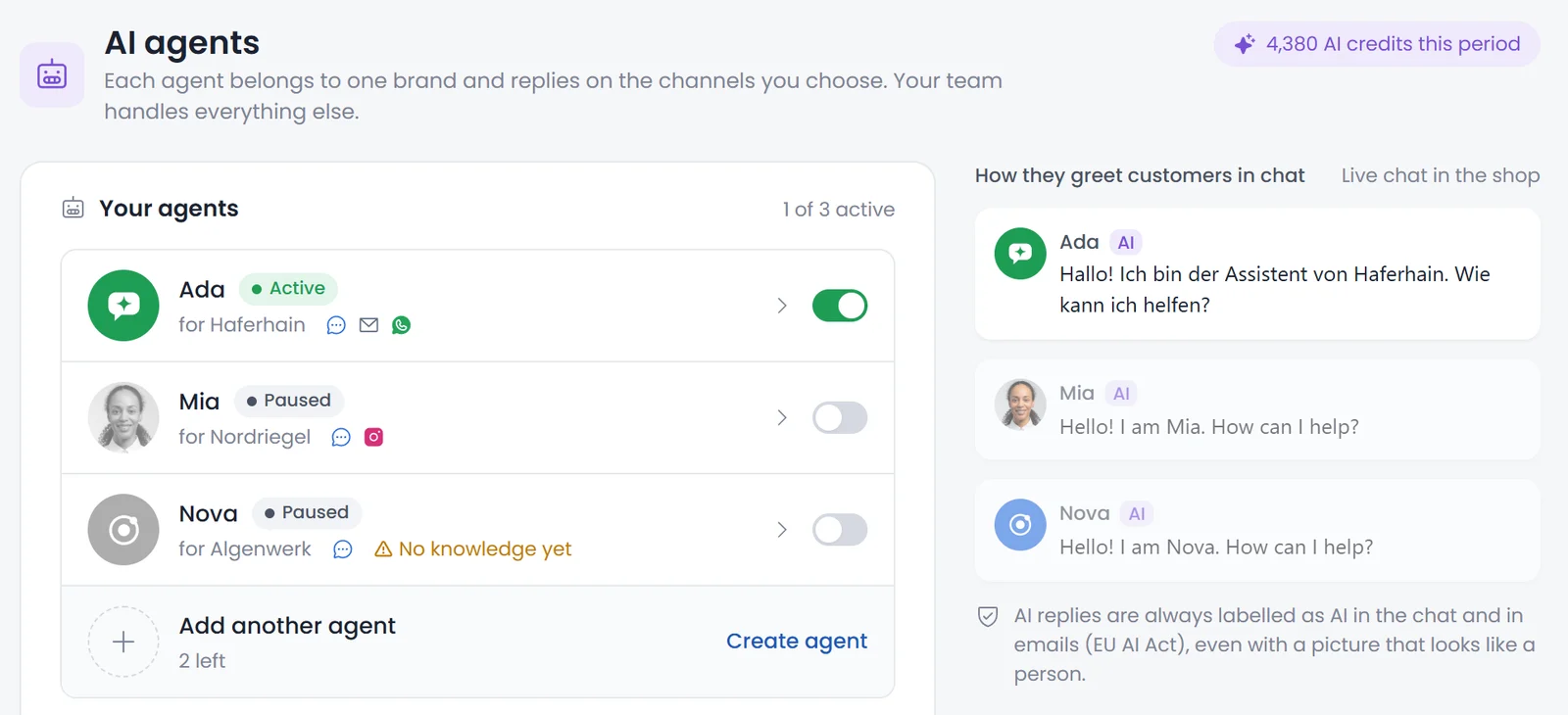
First name, portrait, no notice: the customer takes the bot for a human.Hi, I am Mia, the Haferhain AI assistant. How can I help you?
A name is fine as long as every message makes clear that an AI is writing.What clean labelling looks like
The notice belongs in the bot’s first message, in plain language and without a click. An icon alone or a line in the small print does not reliably meet “clearly distinguishable”.
- Chat widgetGreeting and sender name
KIHi, I am the Haferhain AI assistant. I can help you with orders and shipping.
- WhatsApp, Instagram, MessengerFirst reply in the conversation
KIYou are writing with our AI assistant. Type “agent” if you need a human.
- EmailFirst sentence or a clearly visible line above the reply
KIThis reply was written by our AI assistant. Just reply if you would like to talk to a human.
- PhoneSpoken announcement at the start
KIYou are speaking with the Haferhain AI assistant.
Three things make the difference:
- Sender name
“AI assistant” instead of a first name. That keeps the notice visible in every message.
- A way to a human
The regulation does not require it, but customers accept an AI far more easily when the way out is clear.
- Accessibility
The notice has to exist as text so that screen readers read it out.
Edge cases from daily work
The AI drafts, a human sends
No notice needed if really reviewedBy its wording, paragraph 1 covers systems that interact directly with people. If an employee reads the draft, adjusts it and sends it themselves, the customer is writing with a human. A mere click on “Send” without reading, however, is an AI reply with a detour.
Handover to an employee
Announce the switchSay so when a human takes over, and also when the bot replies again later. Otherwise the customer no longer knows who they are writing with after the handover.
Returning customers
The sender name covers itThe duty applies to the first interaction. If you keep the sender name on “AI assistant” permanently, you do not have to think about it.
AI translation and spelling help
No chatbot notice neededIf a human writes and the AI only translates or polishes, the customer is still interacting with a human. No chatbot notice is needed for that.
AI product images and texts in the store
A different topicThat is a different topic with its own rules (paragraph 4, mainly deepfakes). There is no blanket duty to label every piece of AI content.
What happens in case of violations
Article 99 of the AI Act provides for fines for violations of Article 50:
For small and medium-sized enterprises the lower of the two applies, and the authority has to act proportionately.
In Germany the Federal Network Agency (Bundesnetzagentur) has been the central supervisor since the end of July 2026, under the national AI market surveillance act (KI-MIG). It also runs a complaints office.
Checklist: done in 15 minutes
All ticked. File the screenshots with a date and you are done.
This article is general information from a merchant’s point of view and not legal advice. As of October 2026.
Frequently asked questions
Do I have to label my chatbot as AI?
Yes. Since 2 August 2026 customers must learn by the first message at the latest that they are writing with an AI. The exception for “obvious” cases is narrow and hard to prove in case of doubt.
Is a notice in the privacy policy or legal notice enough?
No. The notice must be clearly distinguishable at the first interaction. That means in the chat itself, not on another page.
Does the duty also apply to WhatsApp and email?
Yes. Article 50 does not distinguish by channel. What matters is that an AI communicates directly with a person.
Can my chatbot have a name?
Yes, as long as it stays clear that it is an AI. “Mia, AI assistant” works. “Mia from customer service” with a portrait photo and no notice does not.
Do I have to label replies an employee writes with AI help?
By the wording, no, if the employee really reviews the reply and sends it themselves. Then the customer is writing with a human.
How high are the fines?
Up to €15 million or 3% of worldwide annual turnover. For small and medium-sized enterprises the lower amount applies.
Sources
- Article 50 AI Act, wording (Regulation (EU) 2024/1689)eur-lex.europa.eu
- European Commission guidelines on Article 50, published 20 July 2026digital-strategy.ec.europa.eu
- Article 99 AI Act, penaltieseur-lex.europa.eu
- German AI market surveillance act (KI-MIG)gesetze-im-internet.de